
Myth: All browser wallets are the same — Why Rabby’s simulation-first, multi-chain model matters for DeFi power users
Start with a common misconception: if you can connect MetaMask to every dApp, then every wallet is functionally equivalent. That’s wrong in ways that matter for anyone who trades complex positions, uses approvals frequently, or manages assets across many EVM chains. The technical surface (a seed phrase, a browser extension, an “approve” button) may look the same, but the underlying decision architecture — how a wallet inspects, simulates, and presents transactions — changes the risk calculus for high-value users.
This article explains the mechanisms behind Rabby Wallet’s approach as a multi-chain extension, why those mechanisms specifically reduce practical risks for DeFi power users in the U.S., where they still leave exposure, and how to choose or configure a wallet based on a simple, reusable heuristic rather than slogans. I’ll correct misconceptions, show where Rabby differs materially from common alternatives, and offer decision-useful rules you can apply today.
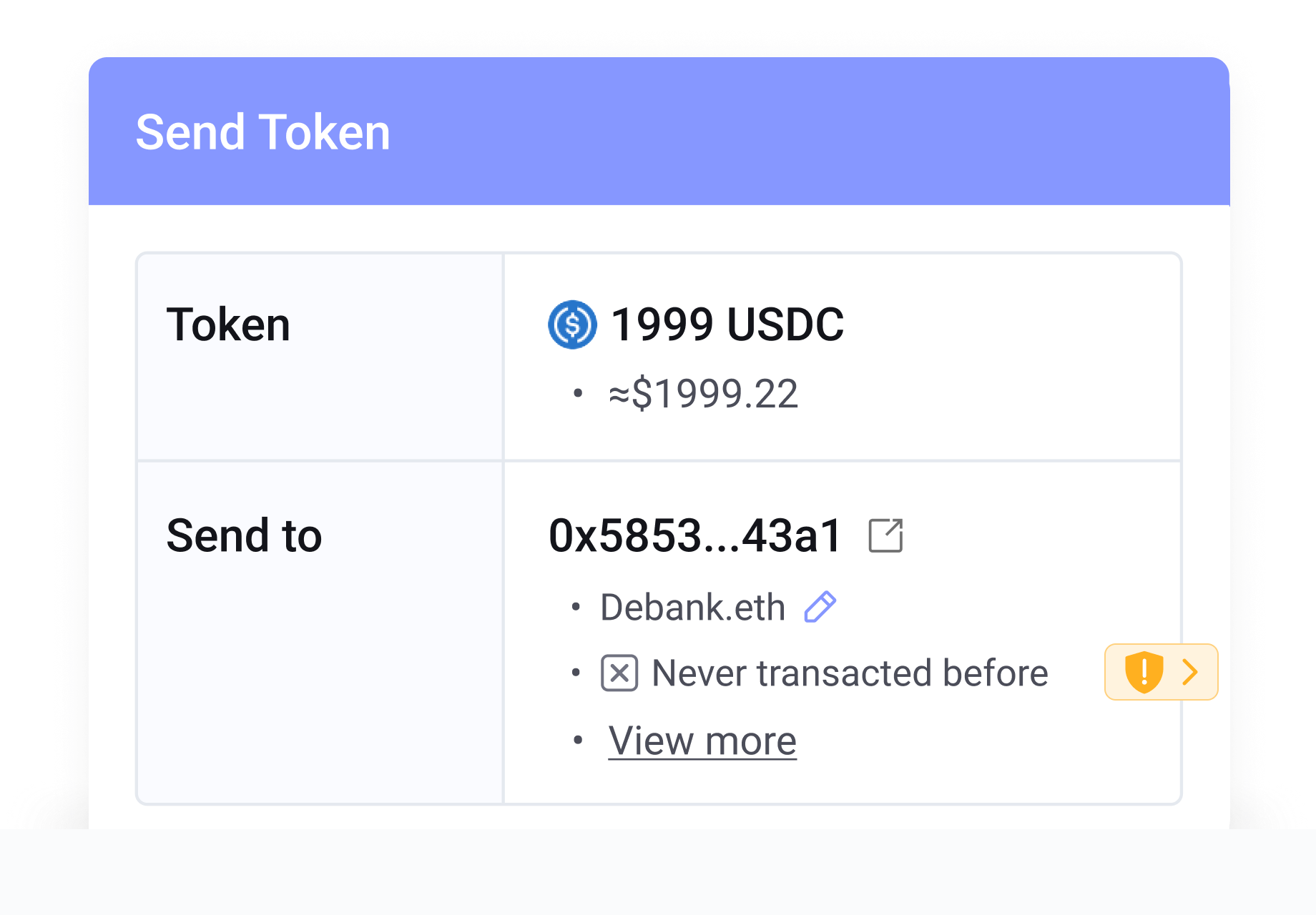
How Rabby’s mechanism differs: simulation, automatic network switching, and pre-sign risk scanning
At the mechanism level Rabby does three linked things that change user behavior and outcomes.
First, Rabby simulates transactions before signing. Simulation is not a cosmetic preview; it executes a dry-run of the on-chain or contract call using a local or RPC-based EVM simulation to show estimated token balance changes and fee costs. That reduces the “blind signing” problem: instead of simply trusting a dApp’s UI or the raw calldata, users see an explicit, system-generated delta of what assets will move where. For a power user juggling LP exits, multi-step swaps, and slippage-sensitive routes, this materially shrinks the surface for accidental transfers or unexpected token drains.
Second, Rabby automatically switches networks based on the dApp you visit. Manual network switching is a persistent human error vector: a user can approve an approval or sign a transaction on the wrong chain, or get stuck with insufficient gas on a forked RPC. Automatic network switching reduces friction and prevents some classes of mis-sent transactions that are costly when operating across 90+ EVM chains (Ethereum, Arbitrum, Optimism, Polygon, BNB Chain, Avalanche, etc.).
Third, Rabby runs pre-transaction risk scans and flags known issues — hacked contracts, suspicious approval requests, and non-existent recipient addresses — before the private key operation. This security engine aggregates pattern recognition (for example, addresses tied to prior exploits) and sanity checks, turning passive warnings into active gating information for the user.
Why these mechanisms matter in practice (and their limits)
Mechanisms are only as useful as the threat model they address. For a DeFi power user in the U.S. the principal threats are: malicious contracts and phishing dApps, wrong-chain or wrong-token mistakes, approval overreach (infinite approvals), and economic losses from gas mis-estimates or frontrunning. Rabby’s simulation and revocation tools directly target those threats: simulations reduce blind signing, automatic switching reduces chain errors, and built-in approval revocation limits long-term exposure from overly generous approvals.
However, this is not a panacea. Simulation depends on accurate RPC responses and the assumption that the simulated state matches the on-chain state at execution time. Rapidly changing mempools or contract state can still create divergence. Rabby’s security engine can flag known-bad addresses, but it cannot reliably detect novel, intelligently obfuscated scams or zero-day contract exploits. The wallet also lacks a built-in fiat on-ramp and native staking — practical limits for users who want on-ramps inside the extension or to stake without leaving the UI.
Importantly, Rabby experienced a notable security incident in 2022 when a Rabby Swap contract was exploited for roughly $190,000. The team froze the contract, compensated users, and increased audits. That incident matters because it demonstrates two things: even projects focused on security can suffer contract-level failures, and an active, responsive remediation process (freeze, compensate, audit) materially reduces systemic loss. When you assess wallets, weigh both preventive controls (simulation, approval revocation, hardware support) and an empirical track record of incident response.
Trade-offs and design choices: non-custodial freedom versus integrated services
Rabby is non-custodial and open-source under MIT license: those features maximize control and auditability. For DeFi power users this is mostly desirable — you keep key control and can integrate hardware wallets (Ledger, Trezor, Keystone, CoolWallet, GridPlus, BitBox02) and institutional providers (Gnosis Safe, Fireblocks). But that same design choice imposes trade-offs. Without a fiat on-ramp users must still rely on centralized exchanges or third-party services for USD↔crypto flows; similarly, the absence of native staking means users must use external staking interfaces or protocols.
Another trade-off is complexity versus convenience. Rabby’s Flip toggle to switch between it and MetaMask as the default wallet is a pragmatic feature for users who want both. But power users must still learn the wallet’s UI, approval revocation flows, and simulation outputs. User education remains a necessary friction — a security feature is only effective if understood and used correctly.
Decision framework: a three-step heuristic for choosing a multi-chain wallet
Here’s a reusable, decision-useful heuristic I use when evaluating wallets as a power user:
1) Threat alignment: match wallet features to the errors that cost you real money. If blind signing and mistaken approvals are your biggest pain, prioritize simulation and revocation tools. If custody with compliance and recovery is your priority, consider institutional integrations.
2) Observable resilience: prefer open-source codebases with reproducible audits and transparent incident histories. Past incidents do not disqualify a project automatically; the security posture and post-incident response do.
3) Operational fit: ensure the wallet supports your primary chains, hardware devices, and workflows (cross-chain gas top-up can be decisive if you frequently bridge into low-gas accounts). Rabby supports over 90 EVM chains and supplies a cross-chain gas top-up feature — useful when you land on a chain with zero native gas.
Apply this heuristic to your own portfolio and you’ll stop making “feature parity” mistakes — you’ll select a wallet based on which errors it prevents for you specifically.
Where Rabby stands relative to common alternatives
MetaMask, Trust Wallet, and Coinbase Wallet are familiar incumbents. Rabby differentiates through transaction simulation, pre-transaction risk scanning, a focus on multi-chain portfolio aggregation, and built-in approval revocation tools. It also integrates tightly with enterprise and multi-sig solutions, which is a plus for teams or funds. On the flip side, if you want in-wallet fiat purchases or a native staking product, those are gaps today.
For U.S. users, regulatory and operational realities also matter: custodial wallets may offer fiat on-ramps and KYC-backed recovery, but at the cost of control and potential regulatory exposure. Rabby’s non-custodial stance avoids those trade-offs, but leaves fiat and staking to third parties.
Practical setup and best practices for power users
1) Use hardware wallets for high-value accounts and link them to Rabby for daily interactions. Rabby’s hardware compatibility lowers the risk of remote key exfiltration.
2) Make approval revocation routine. Treat approvals as temporary privileges you grant to dApps, not permanent keys. Rabby’s revocation UI is designed to make this task straightforward — do it after large interactions and before leaving a protocol for an extended period.
3) Trust simulation outputs but verify critical parameters. For multi-hop routes or approvals involving token swaps, double-check the simulated token deltas, gas estimates, and recipient addresses — especially when slippage or MEV-sensitive paths are involved.
4) Keep an eye on incident history and audit reports. Open-source code plus frequent audits is not perfect, but it lowers systemic uncertainty. After the 2022 Rabby Swap exploit, the team’s public remediation increased confidence; still, stay alert to new disclosures.
What to watch next
Three signals matter going forward: improvements in simulation fidelity (better mempool-aware simulation reduces divergence), expansion of built-in fiat rails (which would change custody trade-offs), and protocol-level standards for approvals (if standards can limit infinite approvals by design, wallets become less of an approval gate). Rabby’s recent positioning as an EVM-first, cross-chain wallet signals focus on multi-chain convenience; watch whether the project adds fiat partnerships or native staking, which would alter its competitive profile.
If you want a quick, authoritative entry point to Rabby’s features and supported platforms, this resource summarizes the extension, clients, and core security features: https://sites.google.com/cryptowalletextensionus.com/rabby-wallet/
FAQ
Q: Does Rabby prevent all scams and hacks?
A: No. Rabby reduces many common user-facing risks by simulating transactions and flagging known-bad addresses, but it cannot prevent zero-day contract vulnerabilities, cleverly obfuscated phishing dApps, or all social-engineering attacks. Simulation helps with blind signing, not with on-contract logical errors that only an audit can reveal. Use hardware wallets, keep approvals tight, and follow responsible exposure limits.
Q: Can I buy crypto inside Rabby with USD?
A: Not yet. Rabby currently lacks a built-in fiat on-ramp, so U.S. users must purchase assets via exchanges or third-party services and then transfer them to Rabby. This is a deliberate separation that preserves non-custodial control but adds an operational step.
Q: How reliable is Rabby’s automatic network switching?
A: Automatic network switching reduces human error by selecting the network a dApp needs, which matters when you operate across many chains. It is reliable for most dApps, but like any UX automation it depends on correct chain metadata in the dApp’s connection request and available RPC endpoints. When in doubt, confirm the chain in the UI before signing complex transactions.
Q: Is Rabby safe to use with institutional custody?
A: Rabby integrates with institutional and multi-sig solutions (Gnosis Safe, Fireblocks, Amber, Cobo Wallet), which makes it usable in institutional workflows. Still, institutional safety depends on operational policies, key management, and third-party custody choices — not just the extension alone.
