
Transaction simulation isn’t optional — it’s the difference between blind signing and informed custody
Many DeFi users still assume a wallet’s job is only to store keys and pop a confirmation box. That assumption is wrong and costly. The real security frontier for active DeFi traders and builders is the pre-signature layer: what the wallet can simulate, scan, and explain before you ever hit “Confirm.” Rabby Wallet pushes that layer forward through transaction simulation, pre-transaction risk scanning, and a suite of controls aimed at reducing the most common failure modes in multi-chain activity.
This essay explains how transaction simulation works in practice, why it matters for power users operating across 90+ EVM chains, where the approach breaks down, and how to choose among Rabby and its main alternatives when safety, speed, and composability are all in tension. Expect mechanism-first description, concrete trade-offs, and decision rules you can use the next time you evaluate a wallet for institutional or heavy DeFi use.
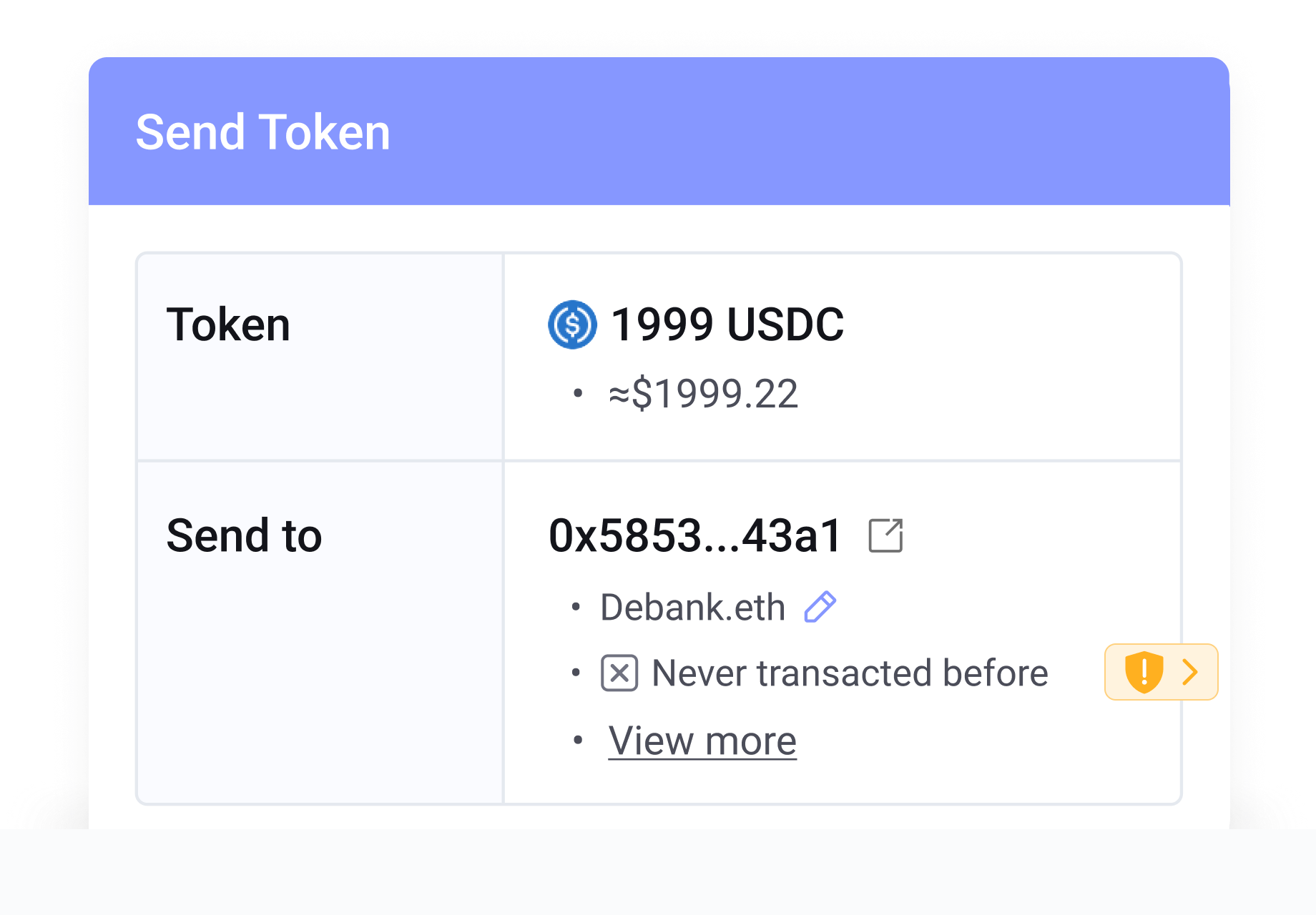
How Rabby’s transaction simulation works — mechanism, not magic
At its core, transaction simulation replays a proposed transaction against a local or remote node to estimate state changes without broadcasting it. Rabby runs this simulation before signing and surfaces the output to the user: exact estimated token balance deltas, fee costs, and a risk scan for known bad actors (hacked contracts, suspicious approvals, or invalid recipient addresses). The practical result is that a user can see precisely which tokens will move and what gas will be consumed — a vital correction to the “approve-and-forget” habit that has cost users funds.
Why the simulation matters technically: smart contracts can bundle multiple changes into a single signed call. A superficially simple “swap” can contain nested approvals, liquidity migrations, or arbitrary token transfers. Simulation turns that opacity into concrete numbers. That said, simulations are models: they assume the on-chain environment doesn’t change between the simulation and the eventual inclusion of your transaction. Front-running, mempool reordering, or a rapid price swing can cause divergence between simulation and result. Rabby’s simulation significantly lowers the odds of signing a malicious or mistaken transaction, but it does not eliminate time-of-execution risk.
Security stack: simulation plus scanning, revocation, and hardware support
Rabby combines several defensive mechanisms that matter more together than in isolation. Transaction simulation offers visibility. Pre-transaction risk scanning flags previously exploited contracts and suspicious approval requests. Built-in approval revocation lets you cancel lingering allowances that are a frequent exploit vector. The wallet supports hardware devices (Ledger, Trezor, Keystone, and others) and integrates with institutional custody / multi-sig suites such as Gnosis Safe, Fireblocks, Amber, and Cobo Wallet. For power users managing large positions or shared treasuries, those integrations allow combining human review, hardware signatures, and Rabby’s pre-checks into a workflow that materially reduces single-point failures.
Practical limitation: Rabby is non-custodial and open-source under MIT, which invites audits but also places responsibility on operators. The project has a real incident in its history — a 2022 exploit of a Rabby Swap contract that led to ~$190k losses — and the team responded with freezes, compensation, and auditing. That episode is useful evidence that the protocol ecosystem remains fallible: simulations and audits lower risk but do not produce a zero-risk environment.
Comparing alternatives: when Rabby is the right trade-off
MetaMask, Trust Wallet, and Coinbase Wallet are household names with broad distribution. Each makes a different set of trade-offs. MetaMask is widely compatible and developer-first; Trust Wallet emphasizes mobile convenience; Coinbase Wallet ties into a centralized exchange ecosystem. Rabby’s distinguishing features for power users are its explicit pre-transaction simulation, automatic network switching across 90+ EVM chains, approval revocation, and deep hardware & institutional integrations. If your priority is minimizing blind-signing across many chains and integrating with multi-sig workflows, Rabby leans toward that use case.
Trade-offs to weigh: Rabby lacks a built-in fiat on-ramp and doesn’t provide native staking flows inside the wallet. If you want a single app where you buy crypto with a card and stake in one flow, other wallets may be more convenient. Conversely, if you prioritize fine-grained control, explicit simulation outputs, and tools to manage approvals and cross-chain gas shortfalls, Rabby delivers those features. The wallet’s cross-chain gas top-up is a pragmatic touch for traders who frequently land on a chain with no gas tokens — it reduces operational friction, but adds an extra action and cost to your workflow.
Where it breaks: realistic limits of simulation and automation
Don’t treat simulation as omnipotent. It neither prevents front-running nor can it guarantee outcome when external actors change state between simulation and mining. Gas estimation is an informed guess, and chains with volatile fees (or mempools dominated by bots) can produce unexpected slippage. Automatic network switching can be convenient but also dangerous if you habitually trust an interface; it can expose you to phishing dApps that impersonate networks. The correct mental model is “simulation as guardrail” rather than “simulation as shield.”
Institutional operators should combine Rabby’s automated checks with policy-level controls: time-delayed multisig approvals, queued review by a security committee, and hardware-enforced private key use. For individual power users, hardware wallets plus approval revocation habits (regularly cleaning allowances) are the most cost-effective way to reduce exposure.
Practical decision framework — three heuristics for DeFi power users
When choosing a wallet for active DeFi across multiple EVM chains, use these heuristics:
1) Risk posture: if your tolerance for blind-signing is near zero, prioritize simulation, approval revocation, and hardware support. Rabby’s combination is tailored to that posture. 2) Workflow integration: if you need institutional custody or multi-sig, prefer wallets that integrate with Gnosis Safe, Fireblocks, or similar — Rabby supporting these integrations is a practical advantage. 3) Convenience vs control: if you insist on an all-in-one fiat-to-stake flow, trade a bit of simulation for convenience elsewhere; if you prefer transparent state before every signature, accept extra clicks.
If you want to try Rabby on desktop or browser and see the simulation UI in action, start here — the extension is available for Chrome, Brave, and Edge, and there are mobile and desktop clients as well.
What to watch next — signals and conditional scenarios
Two signals matter for the wallet-security trade over the next 12–24 months. First, broader adoption of pre-signature simulation and standardized simulation APIs (by wallets and infrastructure providers) would raise the baseline safety for all users. If major wallets adopt richer simulation outputs, phishing and blind-signing losses should decline. Second, wider multi-sig and custody integration at consumer scale (simpler UX for coordinated approvals) would shift custody risk from individuals to audited institutional fences — but it will also centralize certain failure modes. Watch whether regulators in the US press wallets to incorporate identifiable AML/KYC flows; that could change how non-custodial wallets market themselves and what integrations they offer.
Both scenarios are conditional. If simulation becomes standardized and broadly adopted, wallets like Rabby that already embed those checks will look prescient. If regulators or UX pressures move users toward custodial hybrid solutions, non-custodial wallets will need new ways to signal trust and safety to mainstream users without sacrificing decentralization.
FAQ
Q: Does Rabby’s transaction simulation guarantee no losses?
A: No. Simulation reduces the risk of blind-signing and makes the expected token and fee changes explicit, but it cannot eliminate front-running, sudden price moves, or exploits in third-party contracts. Treat simulation as a strong defensive tool, not an absolute guarantee.
Q: How does Rabby compare to MetaMask for multi-chain trading?
A: MetaMask is ubiquitous and developer-friendly; Rabby differentiates with built-in simulation, approval revocation, automatic network switching across 90+ EVM chains, and deeper institutional integrations. If your priority is explicit pre-signature visibility and multi-sig workflows, Rabby has an edge. If you want the broadest dApp compatibility and a massive user base, MetaMask remains competitive.
Q: Should I use Rabby with a hardware wallet?
A: Yes. Combining Rabby’s simulation and risk scans with a hardware wallet (Ledger, Trezor, Keystone, etc.) materially reduces key-exposure risk. Hardware devices provide a physical confirmation layer that complements Rabby’s software checks.
Q: Is Rabby safe for institutional use?
A: Rabby supports integrations with institutional providers like Gnosis Safe and Fireblocks, which enables multi-sig and custodial workflows common in institutional practice. Institutions should still layer policy controls, audits, and operational procedures on top of the wallet’s features.
